

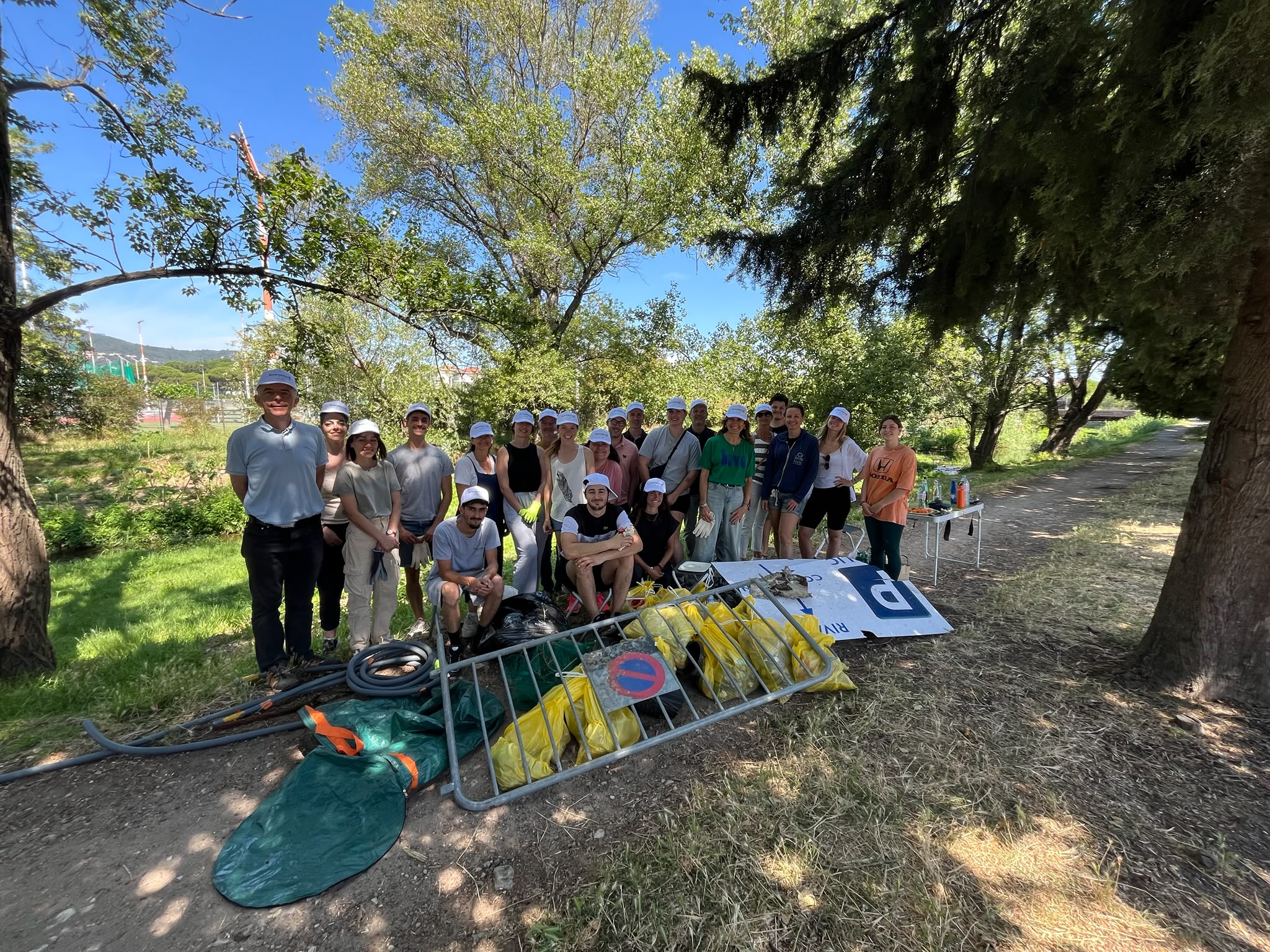
To mark World Oceans Day on 8 June, the Jacques Martel Foundation supported a waste collection initiative on the banks of the Frayère in Cannes, organised by the CSIL (Conseil Scientifique des Iles de Lérins) and carried out by staff from the company Aromatech.
This was also an opportunity to gain a better understanding of the mechanisms behind marine pollution and the issues associated with it.
To begin with, it is important to note that nearly 80% of the waste found in the sea originates on land and is carried there via rivers. Taking action on rivers therefore contributes directly to the preservation of the oceans.
It is important to realise that the large pieces of waste visible on riverbanks or along the coast are, in fact, only the tip of the iceberg, and every piece of waste collected before it reaches the sea helps to limit pollution, the effects of which accumulate over time.
Plastic, in particular, never completely disappears. Under the influence of the sun, wind and friction, it gradually breaks down into increasingly smaller particles; these are known as microplastics and then nanoplatics. Some become so fine that they can no longer be separated from the water. These nanoplastics are then ingested by many marine organisms that are unable to distinguish them from natural particles. This phenomenon fuels the processes of bioaccumulation and biomagnification: the particles and associated substances gradually move up the food chain, with increasingly high concentrations in the predators at the top of the chain.
These issues are particularly acute in the Mediterranean. Although it accounts for only around 1% of the world’s ocean surface area, it is home to nearly 10% of known marine biodiversity, including many endemic species such as Posidonia. With nearly 200 million people living along its shores, the pressures on this exceptional ecosystem are immense.
After an hour of collecting, the bags quickly filled up and the participants were able to see the extent of the pollution, which is not immediately obvious at first glance. Packaging, shards of glass, cigarette butts, tyres, fishing nets, garden hoses, all manner of containers… from the tiniest piece of plastic to much larger items, the variety of waste collected serves as a stark reminder of how much the natural environment remains exposed to human activity.
Protecting the oceans is at the heart of the Jacques Martel Foundation’s mission. Every awareness-raising and fundraising initiative helps to improve understanding of the issues surrounding marine pollution and to encourage more environmentally friendly behaviour.
A big thank you to the teams at Aromatech and CSIL for their commitment during this morning’s event, which was all about raising awareness and taking action.